Stuffed animals, these wonderful accomplices for growing up well
Stuffed animals are essential in children's development and in their access to independence. They have a reassuring function and help them face a changing and sometimes distressing world.
The very first stuffed animals appeared in late 19th-century Germany, but the iconic teddy bear that made them popular has a surprising story behind it.
Looking back at the history of the plush toy and its development during the 20th century, you will see that it is an exciting adventure , with an interesting parallel to be established with the evolution of society itself.

Who invented stuffed animals?
Incredibly, it seems that the teddy bear was invented at the same time in two very distant places and without any consultation between the different creators.
The first teddy bear is German!
According to the Germans, the very first teddy bear was called Friend Petzy, born in the hands of Margarete Steiff, founder of the Steiff toy brand and a world reference in soft toys.
This woman, suffering from paralysis due to polio, took sewing lessons against her parents' wishes in order to become independent. In 1877, she founded a felt business, which today is a sewing workshop . A true visionary, she was already recycling leftover fabrics to create her toys.
A magazine image as a source of inspiration
Despite her severe disability, which forced her to operate her machine with only her left side, Margarete achieved great success with her business. In 1880, she designed elephant-shaped cushions , inspired by an image she discovered in a magazine.
The children immediately embraced the project, so she continued her creations with other animals. The first Steiff catalog was printed in 1892, and by 1901, the brand had been exported to the United States.
Birth of Bear PB 55 after a visit to the zoo

The Steiff brand is a family affair, and Richard Steiff, Margarete's nephew, would play a central role in the history of the plush toy. After a visit to the Stuttgart Zoo, he returned with sketches and entrusted them to his aunt, who created the first teddy bear , the prototype of which was codenamed Bear PB 55. It was a resounding success, and by 1907, production had surpassed one million units.
Oh no! The first teddy bear is American
In fact, the first bear was also American! Michel Pastoureau explains in his book " Ours: Story of a Fallen King " that at the same time, without any contact or exchange, the famous Teddy Bear was born on the other side of the Atlantic.
Tribute to a big-hearted president with Teddy Bear
At that time, bear hunting was common, and when the hunt ended without a single kill, the participants were offered a terrifying consolation prize. This is how the President of the United States, Theodore Roosevelt, found himself faced with a defenseless bear cub to satisfy his hunting instinct. He refused to kill it, and Clifford Berryman drew a caricature of this moment that made the rounds of the newspapers of the time.
The American Articulated Bear is born
Rose and Morris Michtom were inspired by this story to create a mohair bear with articulated limbs. Their Ideal Novelty and Toy Company would go on to produce teddy bears and replicas of the prototype until 1984.
Marcel Pintel offers us the first French teddy bear
Well-known among antique toy collectors, the Pintel brand was the first, in 1921, to offer teddy bears in its collection of stuffed and mechanical toys. Its main competitor, FADAP, followed suit in 1925, both brands being the main references for lovers of antique teddy bears.
The Pintel teddy bear does not have a hump on its back like the German bear. Depending on the model, it has a sad smile or a stern expression. In the 1970s, this same company produced the Colargol bear , the star of a TV show aimed at children.
Since the beginning of the 20th century, stuffed animals have been constantly evolving.

First made from scraps of used fabric, then from mohair, teddy bears have spanned history. They have become witnesses to successive more or less happy eras during which their manufacture speaks volumes about the evolution of lifestyles.
Teddy Bears of the 20s
During this period, glass eyes replaced traditional boot buttons, giving the plush toys a more lifelike appearance. Their deep black pupils were combined with a colorful iris, giving them a more personal touch. In 1921, miniature designer Schuco created a Yes/No model that could move its head up and down and from side to side.
After 1930, teddy bears became more flexible and original.
Initially, manufacturers used straw to stuff the plush toys, which gave them a rather rough look and feel. This was replaced with kapok , a softer plant material, and the plush toys are now pleasant to handle.
Since mohair is an easy-to-dye material, plush toys are available in blue, red, green, and mauve. Beige, brown, and black and white colors are still very popular on the market.
Inventive stuffed animals during the war years
During the sad period of the Second World War, restrictions forced manufacturers to innovate and imagine the use of other materials. This is how sheep's wool , worn blankets and even cotton stuffing entered the creative processes.
The 1950s and their share of innovations
These were the years when major changes in the manufacturing of children's plush toys took place. Nylon made a notable entrance into the toy industry, making possible the creation of the first synthetic plush toys. Woven or knitted, it was combined with synthetic foam or latex padding. Glass eyes were replaced by black or colored plastic elements.
Since 1970, safety has been at the heart of the manufacturing process
Today, all products intended for children are tested by specialized and independent laboratories to meet current safety standards . This requires that the eyes are securely fixed, and flammable materials such as synthetic shavings are replaced with polyester wadding.
The standards are drastic and aim to prevent the child from ingesting a component (eye, bell, etc.), being able to open the plush toy (resistant seams) or risking burning themselves with a flammable material.
A cuddly toy to help children grow

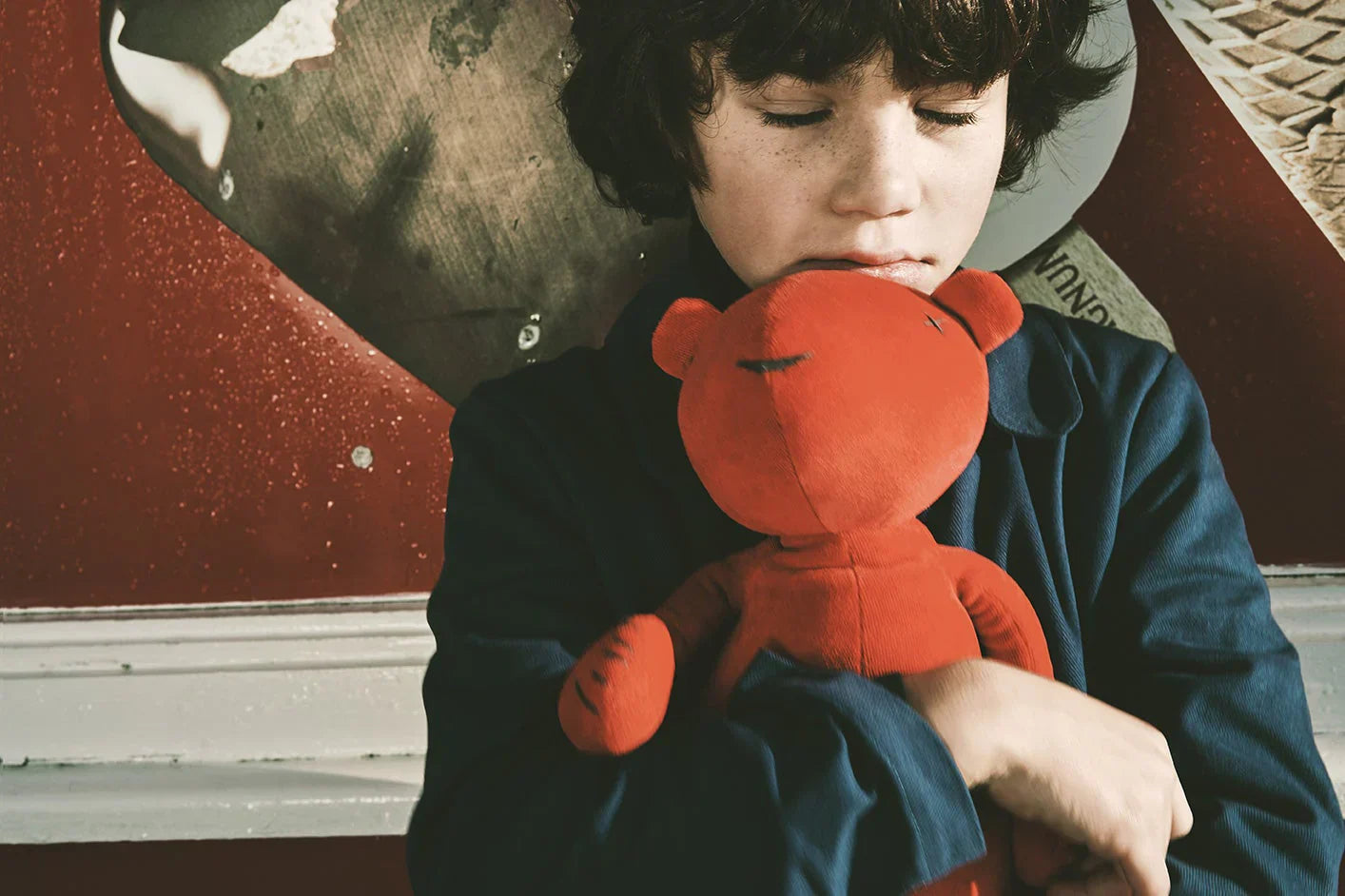
When the stuffed animal becomes a comforter , it is a sign that the child has completely adopted it. For him, it is a precious object that accompanies him in all his discoveries and with which he forges a special bond, of the order of intimacy.
Only a cuddly toy can comfort and reassure
When parents leave the child alone in their room, the comforter helps the young child cope better with this separation and gives them a sense of security . This allows them to experience solitude without anxiety. In fact, the comforter is a bridge between what the child knows (their parents, their environment, etc.) and the unknown (the changes in their daily life).
An important transitional object in the child's development
During the period when the child assimilates that he is a person in his own right, that is to say between 12 and 18 months, the comforter plays a central role. Thanks to it, the child risks exploring new territories and tries experiments under the benevolent eyes of his parents.
The delicate question of washing the comforter
Among the things that reassure children and that adults appreciate much less is their smell! Children are receptive to the different scents they are used to, such as breast milk, their parents, or even soap during bathing. The same goes for their comfort blanket, which they associate with scents that contribute to their emotional comfort.
Not all children are equally demanding when it comes to the hygiene of their cuddly toy. It's possible to get them used to washing their stuffed animal regularly from a very early age by offering them an identical cuddly toy to establish a connection. If the children manage to switch from one to the other, then you'll have earned the right to machine wash the cuddly toy to make it look like new again!
Children's favorite stuffed animals
From a very young age, children have their own tastes and decide for themselves which soft toy will accompany them on all their explorations and comfort them when they need it.
Stuffed animals are the kings of children's rooms.

Stuffed animals representing cats seem to trigger real crushes among children and they come in a multitude of designs. The chubby, realistic, and very soft ones compete with the mischievous, the super cute, or even the Siamese and the lynx.
In the ideal world of stuffed animals, dogs, rabbits, tigers, turtles and dolphins rub shoulders with pandas, lions, flamingos and dinosaurs.
Discover our selection of stuffed animals here!
Imaginary characters
Unicorn plush toys and other fantastical animals allow children to use their imaginations. This is also the case with adorable little monsters to eat or funny associations like the flying pig. Some plush toys are the result of the unlikely encounter between several animals, such as the reindeer-rabbit, which was born in the mind of an original creator.
XXL plush toys
They are gigantic for the small child, which is why they play a protective and reassuring role . What a joy to curl up between the soft paws of a giant bear or to rest by gently resting your head on an XXL dolphin!
For children, it is particularly exhilarating to ride a giant dinosaur or step over a stuffed giraffe to experience a moment of happiness and complicity, quite simply.